Beef Shank: Where the marbling tells a story of texture
Bắp hoa comes from the front shank, its sinew reading like a flower in cross-section. Cut along the grain it stays crisp; cut the other way it turns chewy.

The block of meat was lifted from the pot, still steaming, tied with string around its body like a coil. It rested on the cutting board for a full hour until completely cool, its surface firming up and losing its sheen. Only then did the knife touch it. The first slice fell, thin enough to see through, and in the center of the slice, a translucent, amber-like vein spread out in multiple directions.
Quick Answer: Bắp hoa (flower shin) is a muscle mass from the front leg of a cow, with a strip of tendon running through it. When sliced crosswise, this tendon strip blossoms into a shape reminiscent of a flower petal — hence the name. Because it's a heavily worked muscle, it has a firm texture and a lot of connective tissue, requiring it to be cooked until tender and then completely cooled before it can be neatly sliced thin.
Where on the Cow is Flower Shin Located?
The shin is the muscle in the leg, the most heavily worked area on the entire cow. The more a muscle is worked, the more connective tissue surrounds and interweaves between its fibers — which is why no shin cut can be eaten if only quickly grilled, and also why they are uniquely good when cooked properly. Flower shin typically refers to the cut from the front leg, which is smaller and more compact than the hind leg shin, with a strip of tendon located near its central axis.
What defines flower shin is not the amount of connective tissue, but its location. In most cuts of meat, tendons are evenly distributed as thin membranes between muscle fibers; in flower shin, they gather into a strip running along the length of the muscle. This means that in a single slice, there are two different materials side-by-side — the muscle fibers and the tendon — and they don't tenderize at the same rate. The time collagen needs to transform is thoroughly discussed in the article about oxtail; what's important to remember here is that flower shin requires the cook to manage both components to reach perfection simultaneously, not just one.
The sign of doneness lies at the tip of a skewer, not on a clock. Pierce through the thickest part: the desired sensation is a slight, even resistance, and when withdrawn, the meat should not cling to the skewer. Remove it at precisely that moment, then briefly immerse it in cold water to stabilize the surface. If removed too early, the tendon strip will still be opaque white and tough; if too late, the tendon will have almost completely dissolved, leaving a hollow space in the center of the slice.
The step of cooling completely before slicing is not an unnecessary fuss. When cooled, the gelatin in the meat block solidifies and holds the fibers together, allowing the knife blade to pass through without tearing. If cut while still hot, every slice will have ragged edges, uneven thickness, and the tendon part will be pulled away from the meat. Slice against the grain to shorten the muscle fibers that your teeth have to cut — for the same piece of meat, slicing with the grain will feel significantly tougher, even if cooked identically.
All Shin, Three Cuts, Three Styles
The word "bắp" (shin) in the butcher's shop refers to several different cuts, and the naming can also vary by region, so asking the seller is the surest way when purchasing. Here are three common cuts, each with very different textures:
- Flower Shin — from the front leg, with a tendon strip located centrally and fanning out when sliced crosswise. The ratio of tendon to meat is moderate, so each slice offers both tender muscle fibers and a lightly crisp tendon. This cut yields the most beautiful marbling pattern.
- Core Shin (also known as "lõi rùa" in some places) — a small muscle mass nestled within the hind leg shin, with finer fibers and significantly less tendon. Each animal yields only a very small amount, making it rare, and due to less connective tissue, it also cooks faster.
- Hind Leg Shin (or "bắp giò") — a large cut, with thicker and coarser tendons, requiring more time to tenderize. Once cooked to perfection, the tendon is very satisfying to eat, but the slices do not have the flower-like pattern.
This difference leads to a practical consequence: these three cuts cannot be cooked in the same batch and removed at the same time. Core shin cooks first, followed by flower shin, and hind leg shin last. If all are removed from the pot at once, one cut will always be undercooked and another overcooked.
What a Thin Slice of Meat Reveals When Your Bowl Arrives
Diners can read the entire process described above through a few slices of meat. The tendon streak should be translucent and amber-colored, soft to the bite yet still retaining its form — if it's opaque white and tough, the collagen hasn't transformed properly; if there's only an empty space, it's been overcooked. The edges of the slice should be clean, without ragged fibers, indicating that the meat was properly cooled before slicing.
Thickness is also a signal. A slice should be thin enough for the hot broth to warm it through in a few seconds — the broth's job is not to continue cooking, but merely to warm. If the slice is too thick, the center will still be cold when you eat it, and a chewy sensation will appear even if the meat is fully cooked. This is also why you should eat the meat early, when the bowl is at its hottest.
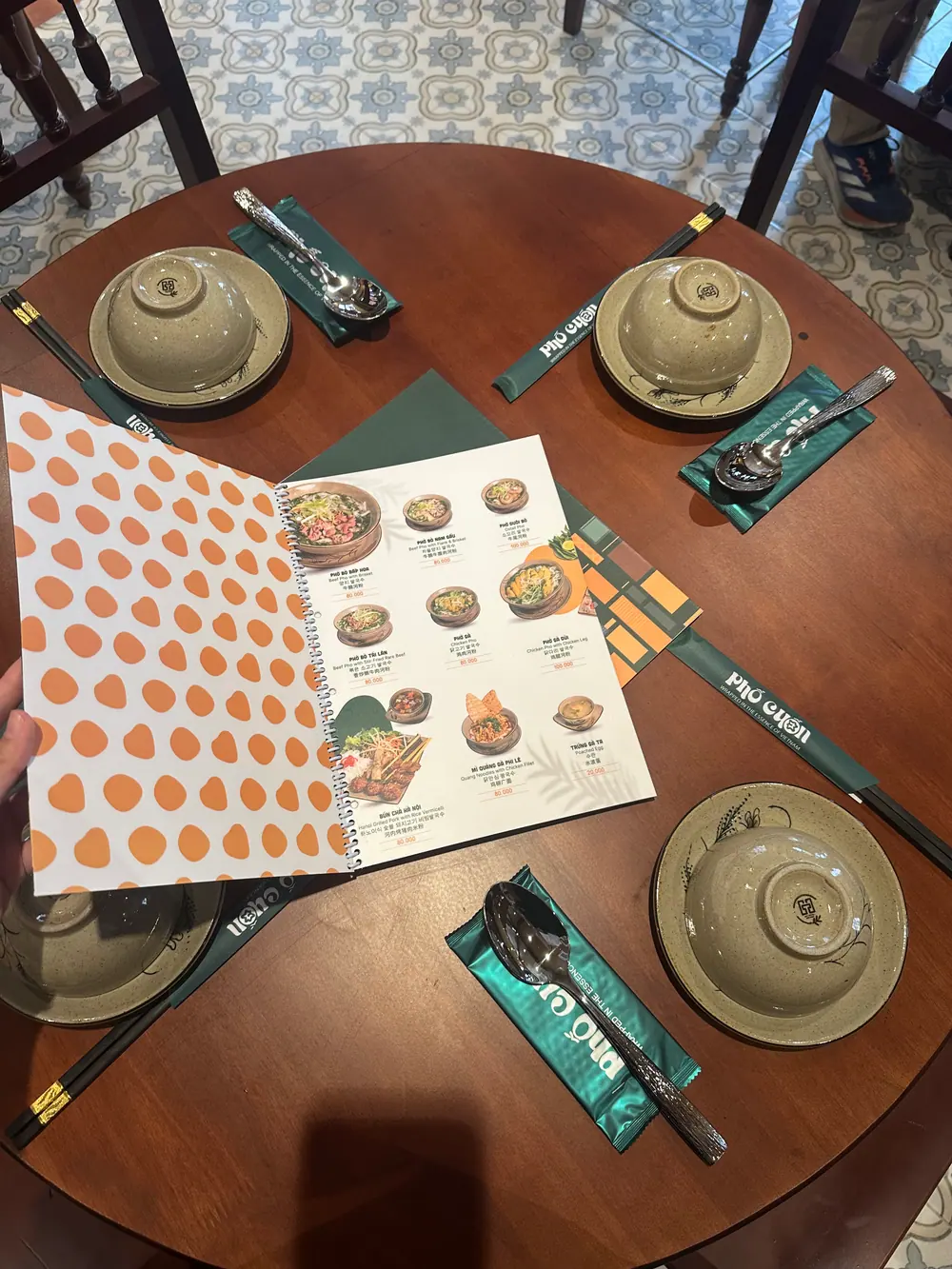
Other cuts of beef tell different stories: flank and brisket point share the lean and fatty axis, oxtail is a lesson in patience. And if you're looking at the menu and need to decide quickly, this comparison table of four cuts does just that. If you want to see the ground floor space before visiting, drop by Phố Cuốn Restaurant's page.
FAQ
Further Questions About Flower Shin
- Why do the tendon patterns on each slice of flower shin differ?
Because the knife is cutting through a three-dimensional block at different positions along its length. Near the ends of the cut, the tendon strip is still gathered, resulting in smaller, denser patterns; towards the middle, it spreads out into a multi-branched shape. From the same piece of flower shin, the first and last slices might look completely different but still be of the same quality.
- What if flower shin is sliced a bit thicker?
The chewy sensation increases faster than you might expect, because a thicker slice means longer muscle fibers for your teeth to cut through. Additionally, the broth won't have enough time to warm the center of the slice between pouring and picking it up. If you prefer a more substantial piece of meat, the shin is not the place to look — cuts with more marbling can handle thickness much better.
- Why tie string around the shin cut before cooking?
To maintain its shape. As collagen tenderizes, the meat block tends to splay along its muscle fibers and expand unevenly; tying it with string keeps it in a uniform cylindrical shape. This is truly significant during slicing: a perfectly round block yields uniformly sized slices, while an uneven block results in varying slice sizes and a tendon streak off-center.