Furama Dining House: One Destination, Four Distinct Flavors
In the same building, four floors, four unique kitchens. Phố Cuốn is on the ground floor — and sometimes, you should take the stairs higher.

From the sidewalk, the building reveals all: signs stacked vertically, each floor a different name, each name a distinct font. Step through the door and you're greeted by a cluster of green, yellow, and pink lanterns hanging from a wooden ceiling, from which four different paths diverge. These four names share the same address, and that's almost all they have in common.
Quick Answer: Furama Dining House isn't one restaurant, but four, stacked within the same building: Phố Cuốn for Vietnamese cuisine on the 1st floor, Thai Siam Kitchen for Thai on the 2nd, Steakhouse The Fan on the 3rd, and Hura Izakaya for Japanese izakaya-style dining on the 4th. Four separate kitchens, four distinct menus, and each with its own operating hours — so please check the schedule for the specific floor you plan to visit before you go.
Why four kitchens stacked on top of each other
This arrangement solves a very real problem when dining in a group: four people in the same car rarely crave the same thing. In a tourist area, the usual solution is to wander around looking for a place that can satisfy most people, and that eats up a good chunk of an evening.
There are two ways out of that dilemma, and they differ in nature. The first is a restaurant that sells everything — a single menu page featuring pho, tom yum, and steak. Convenient as it sounds, it forces one kitchen to master four trades, and the first thing sacrificed is the depth of each. The second way is what stands before you: keeping four kitchens distinct, each with its own brand and name, then stacking them so every table is just a walk away.
The remarkable thing about the second approach is that it doesn't demand compromise from anyone. The person craving pho doesn't have to settle for a bowl cooked by a chef busy with other dishes, and someone desiring a wine-paired meal doesn't have to sit next to a platter of spring rolls. The trade-off is that you need to know what you're looking for before you step inside — something a single restaurant doesn't require of you.
Read the four floors according to what you're craving
Below is how each brand introduces itself. For specific dishes, prices, and service status, you'll need to consult the menu of that particular floor — this article merely provides a map.
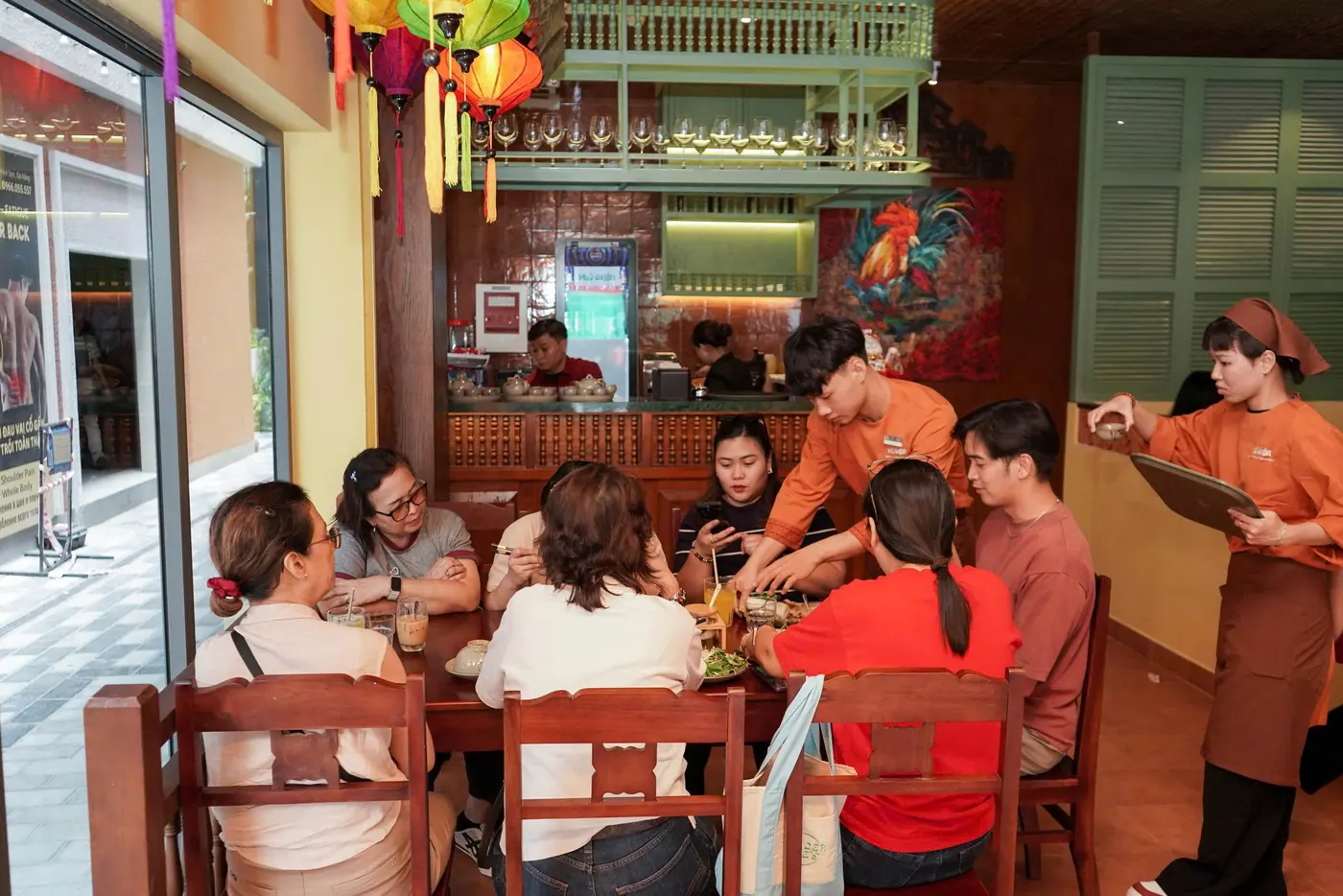
- 1st Floor — Phố Cuốn, Vietnamese cuisine, served all day. Pho and various spring roll platters are the two main groups; the space is designed like a nostalgic street corner with wooden tables and wall-mounted menus. Among the four floors, this is the earliest to open each day.
- 2nd Floor — Thai Siam Kitchen, Thai cuisine, self-named Khun Mae — Mother's Kitchen. Tom yum, som tum, green curry; a space with dark wood and Thai paintings, and according to its own description, it's suitable for large groups.
- 3rd Floor — Steakhouse The Fan, European cuisine. Wagyu and dry-aged Black Angus, featuring a Wine Gallery and private rooms. This floor is for long meals, with wine, and for occasions requiring a more discreet setting.
- 4th Floor — Hura Izakaya, Japanese izakaya-style dining. Charcoal robata grill, hand-skewered yakitori, sake, and highballs. An izakaya is a casual Japanese pub model where people order small plates and linger, making this the floor for late evenings.
The purpose of this map isn't to rank the four floors but to match them with situations. For breakfast, a quick lunch, or a meal where everyone at the table wants familiar dishes, choose the 1st floor. For large groups, many shared dishes, or hot pots in the center of the table, the 2nd floor. For a formal meal, with wine, or requiring a private room, the 3rd floor. And for late evenings, when the group just wants to order small plates and stay until late, the 4th floor.
When to stay on the 1st floor, when to take the elevator
Here's a good way for guests staying in Da Nang for a few days to choose: prioritize what's hard to find elsewhere. Thai food, steak, and Japanese dishes are things you can find in almost every major city; a freshly cooked Vietnamese meal with daily-picked vegetables is much harder to replicate. If you only have one or two meals, the 1st floor is a reasonable place to start, and the 1st floor menu is where to preview what it offers.
Conversely, there are three situations where taking the elevator up is the right choice, with no regrets. One, someone at your table can't eat Vietnamese food — this happens more often than people think, especially with children traveling with families. Two, you've had Vietnamese food for several consecutive meals and your palate needs a change. Three, your occasion calls for a different setting: a celebration, a meal with guests, or a meal requiring a private space.
One more point needs to be clarified as it often disrupts plans: the four floors do not share the same operating hours. Each kitchen operates according to the rhythm of the cuisine it serves, and these hours do not overlap — some floors open early in the morning while others are still dark, and vice versa late at night. Therefore, don't infer the hours of one floor from another; check the schedule for the specific floor you intend to visit, and if you're a large group, book a table in advance. Directions to the An Thượng area and what's available nearby are detailed in the article about Phố Cuốn in the An Thượng area, while the story behind the 1st floor's name is in the article about the Phố Cuốn brand. The 1st floor's introduction page is at Phố Cuốn.
FAQ
Ask before choosing a floor
- Why does each floor have its own operating hours?
Because service hours follow the type of cuisine, not the building. A pho kitchen thrives in the morning, so it must open very early, and most of its customers have finished eating before the upper floors begin their day. A Japanese izakaya, conversely, sees its customers arrive after dinner and stay late, so opening early would mean opening to an empty room. Steak and Thai food fall somewhere in between. The four floors thus operate on four different rhythms inherent to their cuisines, so forcing them into a common schedule would harm all four.
- If I only have one meal in Da Nang, which floor should I choose?
If you want a concise answer, the 1st floor, for the simple reason that freshly prepared local Vietnamese dishes are hard to find once you leave this city. But the question should be rephrased once before finalizing: Is this meal for you or for the whole group? If it's for the entire group and someone genuinely can't eat Vietnamese food, then a meal where everyone is comfortable is still better than a "by-the-book" meal where one person just watches.