Cinnamon, star anise, black cardamom: the aromatic symphony of the broth
Cinnamon gives warm sweetness, star anise a round finish, black cardamom a layer of smoke. The three enter the pot in order, and the bowl hears it.

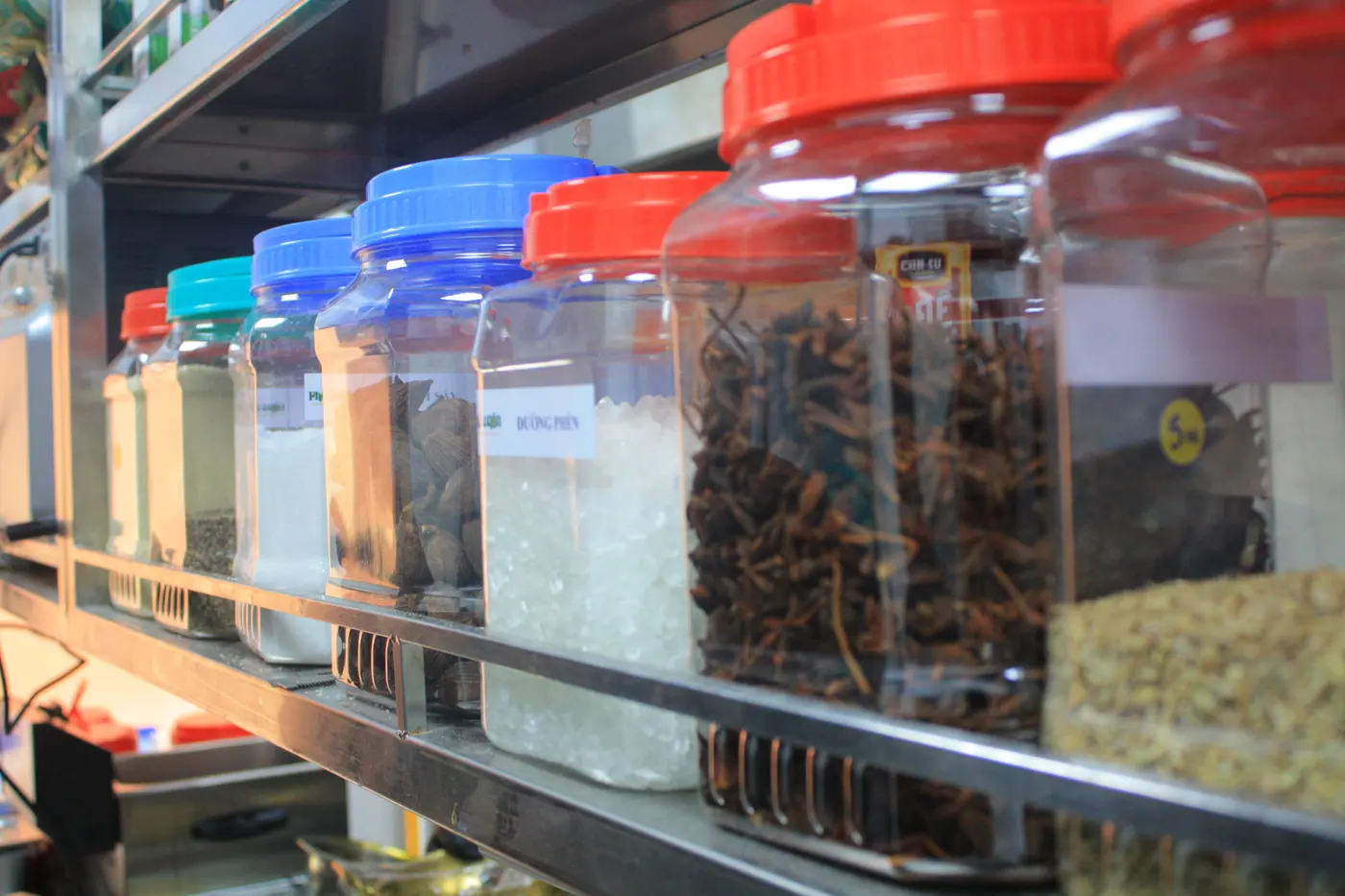
On the kitchen shelf, a row of glass jars stood neatly, each with a different colored lid. The assistant chef reached for the star anise jar, poured four petals into their palm, counted them, and then returned the jar to its place. The cast iron pan on the stove was hot but not yet smoking. In just a few more minutes, the entire kitchen would smell like a cold winter morning, even though it was August in Da Nang outside.
Quick Answer: Cinnamon provides a warm, sweet base, star anise offers a round, licorice-like finish, black cardamom adds a smoky layer and depth; coriander seeds brighten the whole ensemble, while roasted onion and ginger connect these dry aromas with the meat flavor. They don't all go into the pot at the same time, nor do they stay until the very end — the timing of their removal is as crucial as their quantity.
The Journey of Dry Spices into the Broth Pot
Looking at a list of cinnamon, star anise, and cardamom, one might easily assume these are imported ingredients. In reality, most of them are agricultural products from Vietnam's own highlands: star anise is associated with Lạng Sơn, cinnamon with Trà My and Yên Bái, and black cardamom grows under forest canopies in the northern mountainous provinces. Their journey down to the pho pot in the lowlands is one of traders and local markets, not of ocean-going vessels.
This explains another point: there is no "national ratio" for pho spices. Each region leans towards what it has in abundance, and each cook maintains their own unique blend, like a signature. The National Tourism Portal lists cinnamon, star anise, cloves, black cardamom, and coriander seeds in modern pho broth versions — a list of possibilities, not a mandatory recipe. This article discusses the role of each ingredient; for specific ratios in a particular kitchen, you'd have to ask that very kitchen.
Who Speaks First, Who Lingers Last
Toasting is the step that allows the essential oils within the seeds to expand and become aromatic. Use low heat, a dry pan, stir constantly, and stop as soon as the aroma becomes distinct. Over-toasting cinnamon is easy to spot: its sweet edge disappears, replaced by a dry, slightly bitter, dusty smell. For star anise, the petals turn a dark brown, almost black. Overdoing it at this stage cannot be fixed by adding less later — the bitterness is already inherent in what you're about to put into the pot.
In the mouth, these three spices don't speak at the same time. Star anise arrives first, in the nose, because its aromatic molecules are highly volatile — this is what you smell when the bowl is still a hand's width from the table. Cinnamon is what lingers longest on the palate, providing a warm and slightly sweet sensation. Black cardamom appears later, in the breath after swallowing, carrying smoky notes and a very subtle hint of camphor. Coriander seeds don't have a strong enough individual note to be memorable, but without them, the whole ensemble feels dark and heavy.
The time they spend in the pot also completely changes their character. Simmered for too long, star anise turns medicinal, cinnamon becomes astringent, and both begin to overpower the meat flavor — precisely what they are there to enhance. The simplest way to control this is to wrap the spices in a loosely tied cloth bag, add it in the final stages, taste every fifteen to twenty minutes, and remove the bag as soon as the aroma is discernible but the meat flavor still takes precedence.
This is also why pre-ground five-spice powder cannot be a substitute: the powder cannot be removed from the pot. It dissolves into the water, staying wherever it goes, and brings fine powder that can cloud the broth. Once you've overdone it, there's no going back.
Spice Bag for a Pot Serving Four
The ratios below are a starting point for home cooks who need a place to begin experimenting; it is not a restaurant recipe, and each kitchen maintains its own unique blend.
- 2 small cinnamon sticks, about the size of a pinky finger
- 4 to 5 whole star anise pods
- 1 black cardamom pod, lightly crushed to crack the shell
- 1 teaspoon coriander seeds
- 1 roasted onion and 1 roasted ginger knob, kept separate from the bag
- A clean cheesecloth and string
Instructions:
- Toast each group separately over low heat, as each cooks at a different pace; stop when the aroma is distinct.
- Let them cool completely, then place them in the cloth bag, tying it loosely so water can still circulate.
- Drop the bag into the pot during the last forty-five minutes; add the roasted onion and ginger directly.
- Taste every fifteen minutes, removing the bag as soon as the aroma is sufficiently clear, don't wait until it becomes dominant.
If the aroma is too faint the first time, increase the steeping time next, don't rush to increase the amount of spices. Extending by ten minutes is a reversible change; adding another star anise pod is not.

The Aroma Precedes the Bowl of Pho by a Few Steps
There's a moment before the bowl of pho touches the table: the guest smells it. What arrives first isn't the smell of meat, but star anise and roasted ginger, the two lightest elements in the entire pot. This order isn't accidental — it's the physical order of volatile molecules, and it's also why a cold bowl of pho loses much of its appeal even if the flavor remains intact.
Next time, try taking three seconds to smell the bowl before picking up your chopsticks. If you detect star anise first, then cinnamon, the aromatic ensemble is playing at its correct rhythm. If there's only one dominant aroma overpowering everything else, that's usually a sign of a spice bag left in the pot for too long.
To read more, there's the story of the broth pot — where this aromatic ensemble does its work; the journey of pho from North to Central Vietnam — why each region has its own blend; and the sequence of experiencing a bowl of pho. If you want to see it firsthand, Phố Cuốn restaurant's page has photos of its open kitchen on the first floor.
FAQ
Questions About the Spice Jars
- Can cinnamon and star anise be replaced with five-spice powder?
Yes, but you lose control. Ground powder dissolves into the water and cannot be removed, so once the aroma is too strong, there's no way to adjust it; it also clouds the broth due to the fine powder. Pre-ground mixtures also have fixed ratios, often heavy on cloves and fennel, making the pho pot more likely to taste like a stew.
- Why do some pho bowls have an overly pungent star anise aroma?
It's usually because the spice bag was left in the pot for too long, not because too much was added. Star anise continues to release its aromatics throughout the steeping time, and past a certain threshold, the pleasant licorice note turns medicinal. The second reason is over-toasting: if the star anise petals turn black, they already carry a bitter taste before entering the pot.
- Is black cardamom mandatory?
No. Many good pho broths don't use black cardamom, and no one considers it a deficiency. What it contributes is a very subtle smoky layer in the finish, which makes the broth feel "deeper." If omitted, you'll have a brighter and cleaner bowl of pho — different, but not inferior.